

Table of Contents
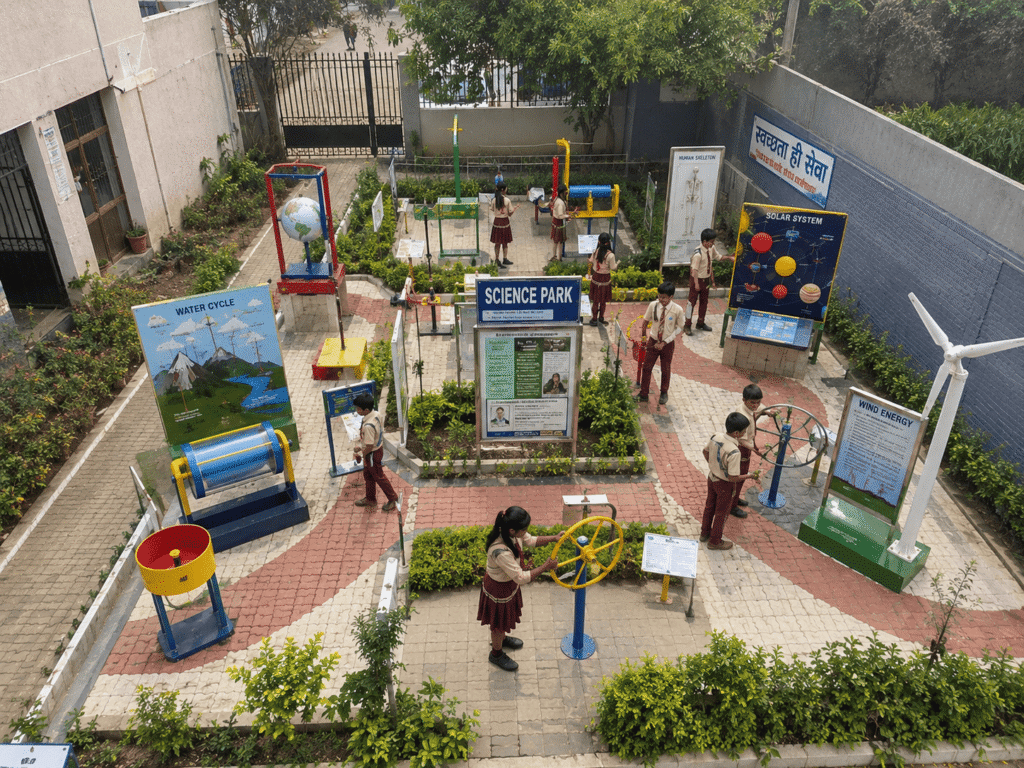
Knowing How Much Space is Required for a School Science Park is one of the most common questions school owners, principals, and educational trusts ask during infrastructure planning. Many institutions believe a science park requires a massive campus, but that is not always true.
A properly designed science park can be developed in a compact area while still delivering excellent educational value.
The real challenge is not the size of the land.
The challenge is planning the space correctly.
Poor layouts often create:
- Congested pathways
- Reduced student interaction
- Safety concerns
- Limited future expansion
- Lower educational impact
This guide explains how much space schools should allocate, how layouts should be designed, and how institutions can maximize educational value from available land.
Why Space Planning Matters
Science parks are educational environments.
Students should be able to:
- Move safely
- Interact comfortably
- Observe scientific demonstrations
- Participate in group learning activities
Poor space planning reduces learning effectiveness.
Proper planning improves:
- Student engagement
- Equipment utilization
- Safety
- Future scalability
Many school infrastructure development projects underestimate the importance of layout planning.
The result is a science park that feels crowded despite having adequate land.
How Much Space is Required for a School Science Park Minimum Area
The required area depends on project objectives.
Small School Science Park
Suitable for:
- Primary schools
- Small private institutions
| Component | Recommended Area |
|---|---|
| Educational Models | 500–800 sq. ft. |
| Pathways | 200–300 sq. ft. |
| Open Space | 200–400 sq. ft. |
Total Area: 1,000–1,500 sq. ft.
This configuration can accommodate basic open-air physics models and educational exhibits.
Medium School Science Park
Suitable for:
- CBSE schools
- ICSE schools
- Educational trusts
| Component | Recommended Area |
| Science Models | 1,200–1,800 sq. ft. |
| Walkways | 500–700 sq. ft. |
| Activity Areas | 300–500 sq. ft. |
Total Area: 2,000–3,000 sq. ft.
This size allows multiple learning zones.
Large Educational Science Park
Suitable for:
- Large campuses
- Government schools
- Educational complexes
| Component | Recommended Area |
| Science Models | 3,000–5,000 sq. ft. |
| Walkways | 1,000–1,500 sq. ft. |
| Activity Areas | 1,000+ sq. ft. |
Total Area: 5,000–8,000+ sq. ft.
Large parks can support advanced learning experiences.
Recommended Science Park Layout
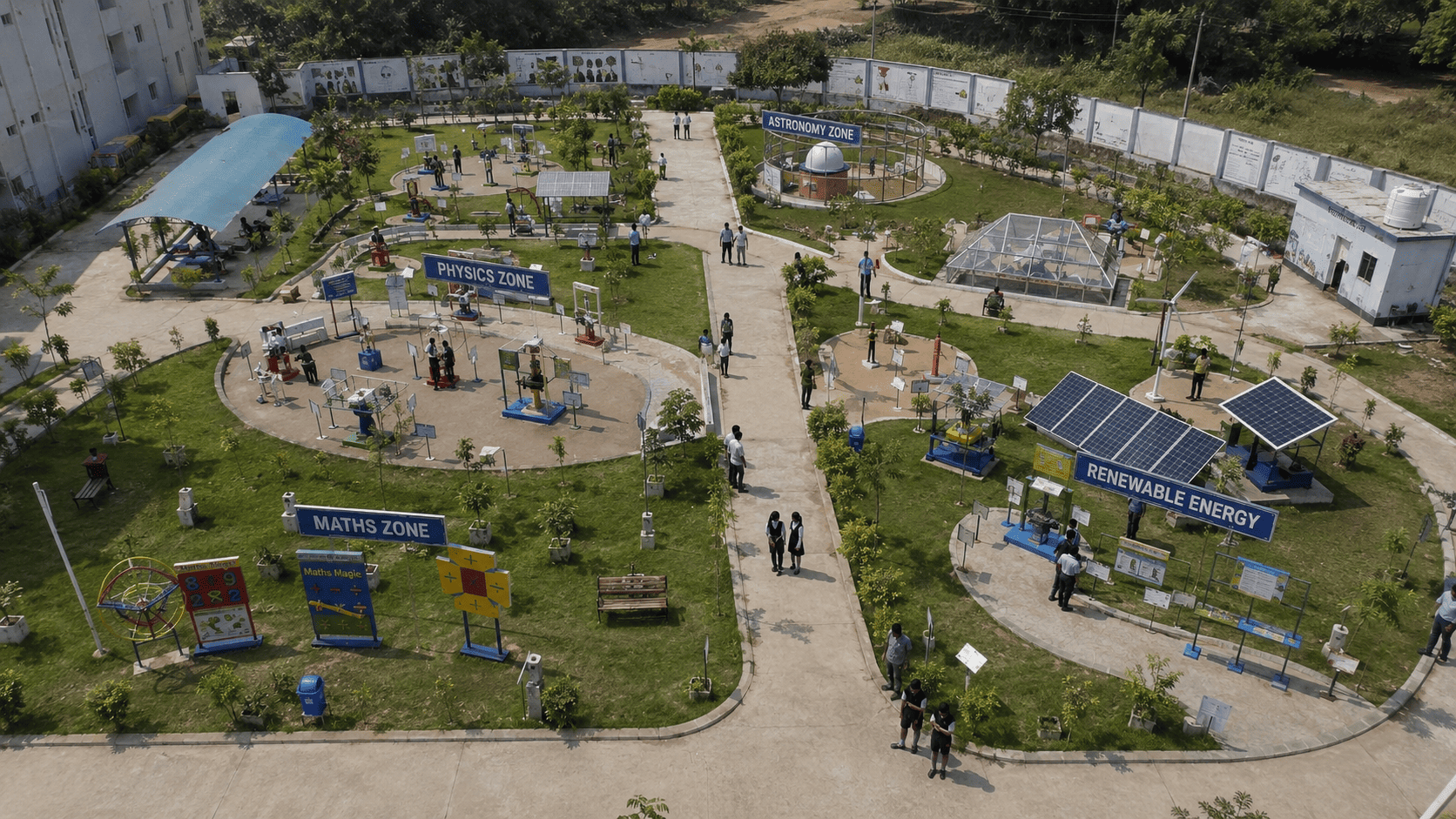
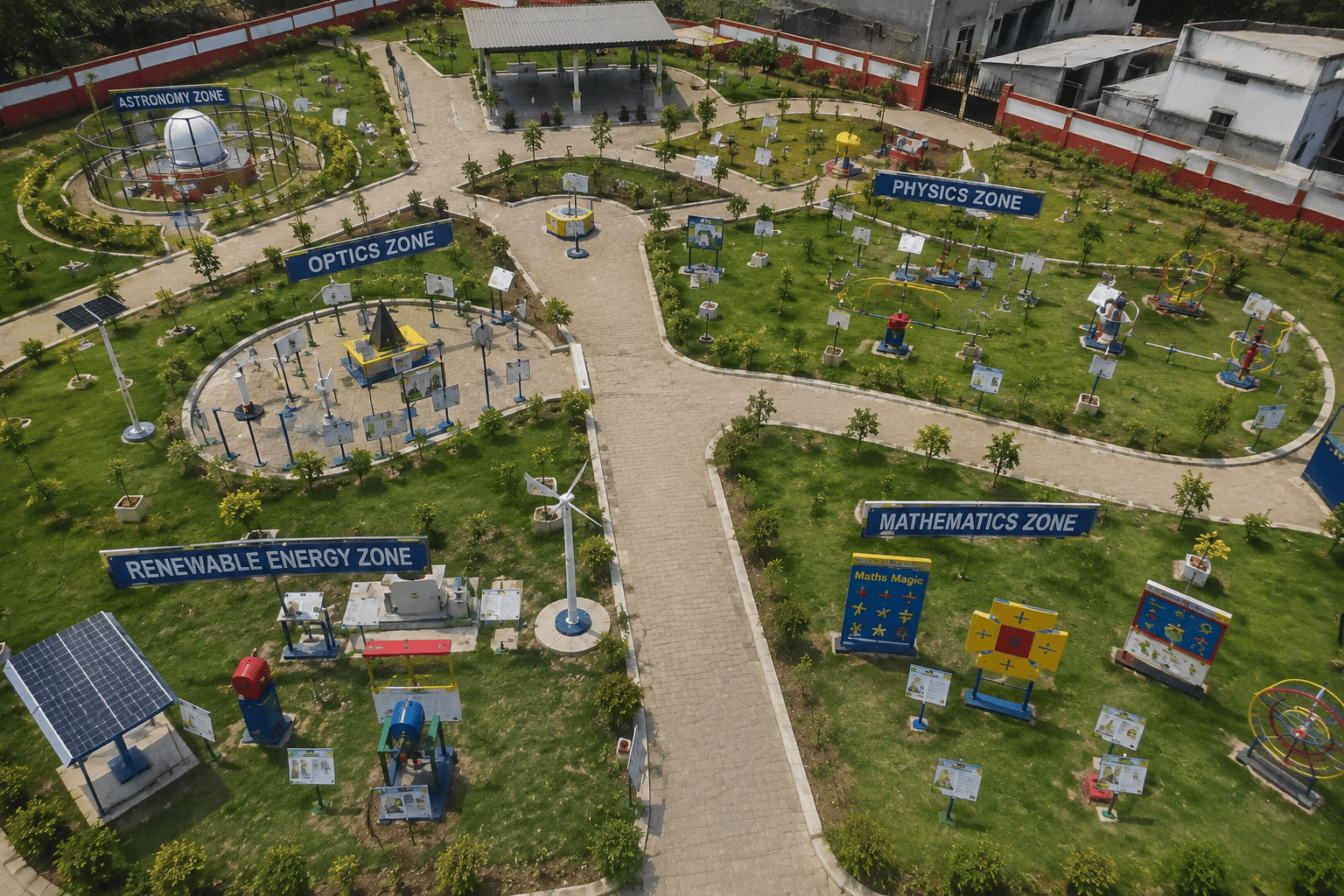
Space should be divided into dedicated learning zones.
Physics Zone
Includes:
- Pendulum models
- Wave demonstrations
- Open-air physics models
- Force and motion exhibits
Mathematics Zone
Includes:
- Geometry exhibits
- Symmetry models
- Puzzle stations
Optics Zone
Includes:
- Periscopes
- Reflection models
- Optical illusion exhibits
Renewable Energy Zone
Includes:
- Solar demonstrations
- Wind energy exhibits
A zoned layout improves educational flow.
Factors That Influence Space Requirements
Every project is different.
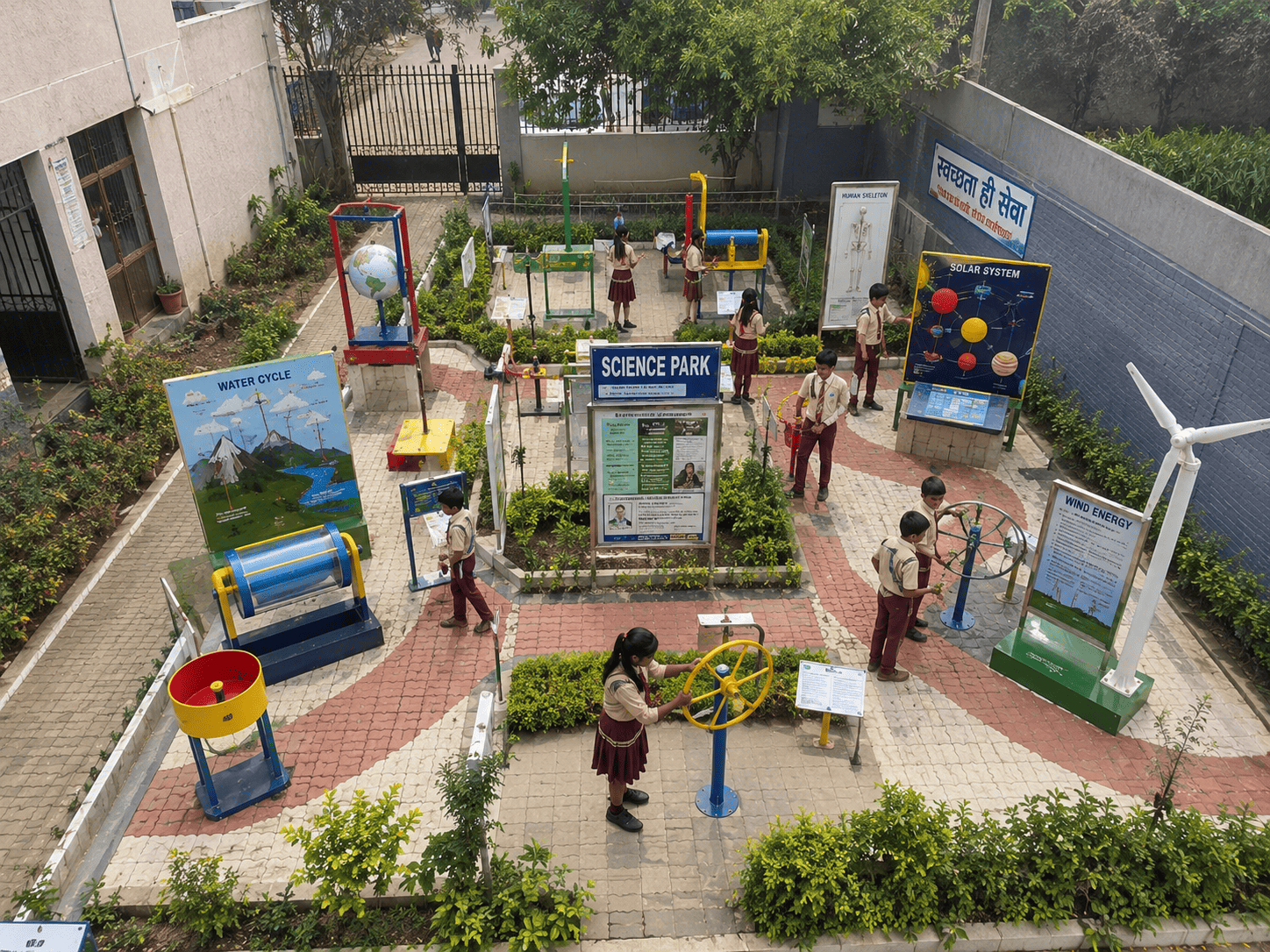
Several factors affect the final space requirement.
Student Strength
Schools with larger student populations need wider pathways and larger activity areas.
Number of Models
More equipment requires more space.
Many institutions start with 10–15 models and expand later.
Curriculum Objectives
Schools focusing on STEM education may require additional exhibits.
Future Expansion Plans
Always reserve space for future additions.
Expansion becomes expensive when layouts are not planned correctly.
Safety Requirements
Adequate spacing between equipment is essential.
Students should never feel crowded.
How to Maximize Educational Value in Limited Space
Limited space does not mean limited learning.
Many schools successfully create compact science parks.
Use Multi-Concept Models
Select equipment that demonstrates multiple scientific principles.
Create Circular Learning Paths
Circular pathways improve student movement.
Prioritize High-Impact Models
Focus on:
- Pendulum demonstrations
- Whispering dishes
- Energy conversion exhibits
- Optical models
Combine Learning Zones
Smaller campuses can integrate related concepts.
This reduces space requirements without reducing educational value.
Material Selection and Long-Term Planning
Material quality influences project success.
Educational equipment remains exposed to:
- Sunlight
- Rain
- Humidity
- Dust
Many institutions prefer FRP-based systems because they offer:
- Corrosion resistance
- Low maintenance
- Long service life
Science parks are often integrated with:
- FRP multiplay systems
- Outdoor learning spaces
- Educational activity zones
This creates a more comprehensive learning environment.
Reliable B2B park equipment suppliers can help optimize layout and equipment selection.
Why Bravia Fibrotech
Bravia Fibrotech provides customized educational infrastructure solutions for schools, educational trusts, government institutions, and municipalities.
Core offerings include:
- Science Park Equipment
- Playground Equipment
- FRP Products
- Outdoor Gym Equipment
The company supports projects through:
- Site assessment
- Layout planning
- Manufacturing
- Installation
- Technical consultation
Whether the requirement is a compact science park or a large educational campus, Bravia Fibrotech focuses on durable and practical solutions.
Frequently Asked Questions
What is the minimum area required for a school science park?
Most schools can start with 1,000–1,500 square feet.
Is 2,000 square feet enough for a science park?
Yes. A 2,000–3,000 square foot area can support a well-designed educational science park.
Can science parks be expanded later?
Yes. Future expansion should be considered during initial planning.
Which science models are most important?
Pendulum models, optical exhibits, sound demonstrations, and renewable energy exhibits are highly effective.
Does a science park require regular maintenance?
Yes. Periodic inspection and cleaning improve lifespan and performance.
“Planning carefully ensures you know exactly How Much Space is Required for a School Science Park before starting development.”
Request a Catalog or Factory-Direct Quote
Bravia Fibrotech is a leading manufacturer and supplier of Science Park Equipment, Playground Equipment, FRP Products, Outdoor Gym Equipment, Educational Park Infrastructure, and Customized Learning Solutions for schools, government institutions, municipalities, and infrastructure projects across India.
Our solutions include:
- Science Park Equipment Manufacturing
- Playground Equipment Supply & Installation
- FRP Educational Models
- Open-Air Physics Models
- Outdoor Science Lab Equipment
- FRP Multiplay Systems
- Outdoor Gym Equipment
- Turnkey Educational Infrastructure Projects
Whether you are planning a school science park, government educational project, municipal learning zone, or public infrastructure development, our team can assist with planning, manufacturing, installation, and technical consultation.
Website: https://www.braviafibrotech.in
Contact: +91 9145240111
+91 7517077511
Email: contact@braviafibrotech.in
Request a product catalog, technical specifications, project references, and a factory-direct quote today.